
Bali attracts more first-time remote workers than almost anywhere else in Southeast Asia, and most of them make the same avoidable mistakes in the first ninety days. Being a digital nomad in Bali rewards preparation far more than enthusiasm — the visa chosen, the area picked, and the internet setup decided in week one shape almost everything that follows.
This guide is built around decisions rather than descriptions. Every section below answers the same five questions: why it matters, when it applies, who it suits, what people get wrong, and what to actually do about it.
Quick-Reference: Is Bali Right for This Nomad Profile?
Why Bali Remains the Digital Nomad Capital of Southeast Asia
Cost of living relative to income is the core driver, but it is not the whole story. Bali's advantage over rivals like Chiang Mai or Da Nang is community density — enough long-stay foreigners that coworking spaces, English-speaking healthcare, and specialist visa agents have all matured into reliable industries rather than workarounds.
Insider observation: the island's nomad population is not evenly distributed by season. April–September (dry season) sees coworking spaces and popular cafés visibly busier, with better networking opportunities but higher accommodation prices. October–March is quieter and cheaper, with the trade-off of daily rain disrupting scooter commutes.
Who this suits best: remote workers who value community and infrastructure over pure novelty. Those wanting total anonymity or a less "discovered" destination may find Bali's nomad density a downside rather than a benefit.
Digital Nomad Visas: How to Live and Work in Bali Legally
This is the section where most competing guides fail readers — either oversimplifying to "get a visa" or burying the actual decision in legal jargon. Two categories matter in practice.
Visa Decision Framework
Visa Decision Tree (Visual Walkthrough)
For a faster gut-check, walk through this before consulting an agent:
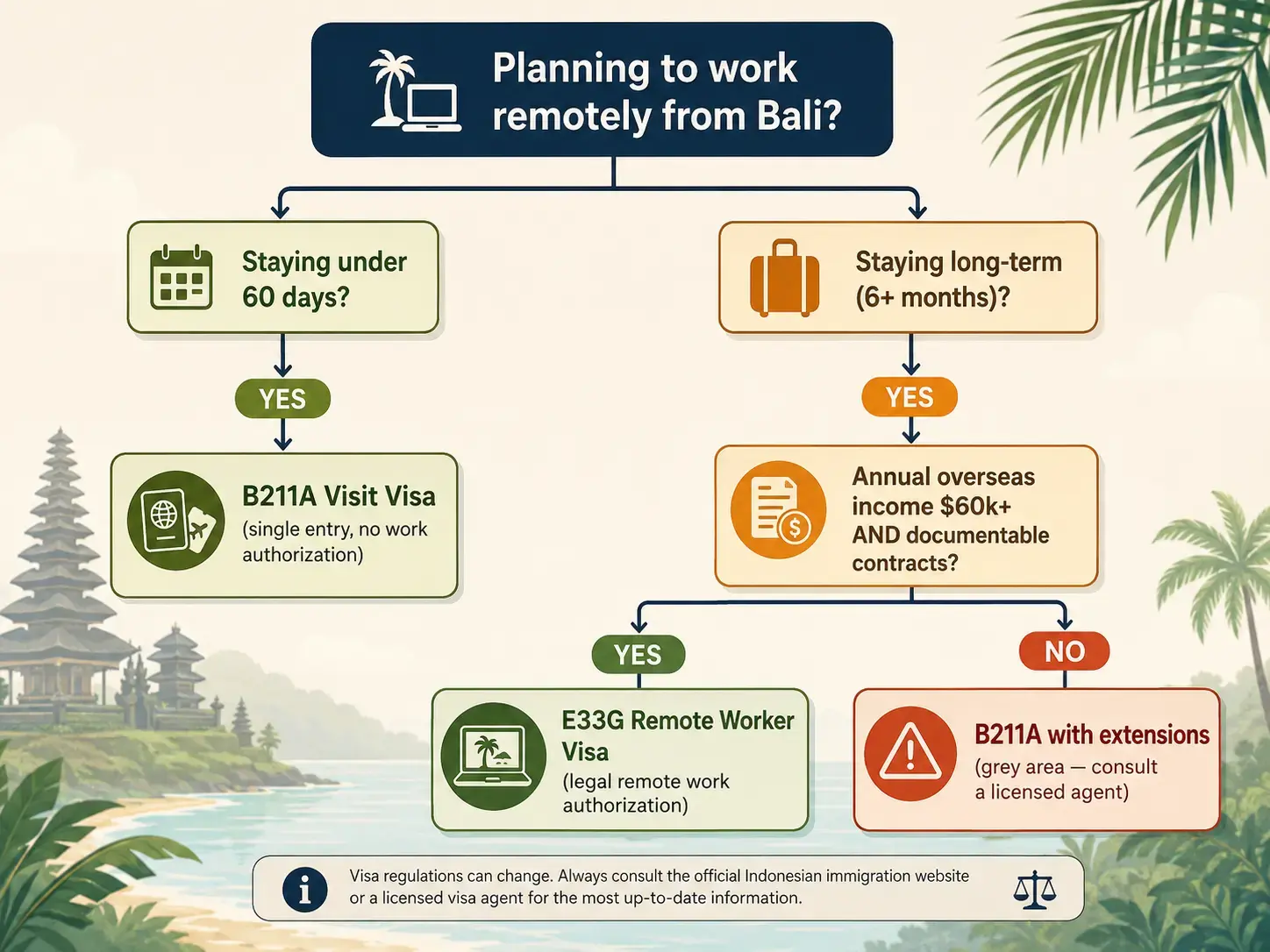
This tree is a starting filter, not a substitute for professional advice — income thresholds and enforcement patterns shift periodically, so confirm current figures with a licensed agent before applying.
The E33G Remote Worker Visa: Requirements and Process
The E33G Temporary Stay Permit (Remote Worker KITAS) is the only category that explicitly authorises remote work for foreign-registered employers or clients while physically based in Indonesia.
Typical requirements at time of writing:
- Employment or client contracts with a company registered outside Indonesia
- Minimum annual income around $60,000 USD (verify current threshold with a licensed agent, as figures are periodically revised)
- Personal bank balance of approximately $2,000 USD
- Valid for 12 months, generally renewable
Step-by-step process most applicants follow:
- Engage a licensed visa agent (self-filing is possible but rarely faster or cheaper once errors are factored in).
- Submit income and bank evidence for verification.
- Complete biometric and document processing, typically 2–4 weeks.
- Collect the permit and register local address (STM) within the required window after arrival.
Common mistake: assuming freelance platform earnings (Upwork, Fiverr) automatically qualify as "employment" evidence. Agents often need supplementary contracts or invoices to satisfy the income requirement — sort this before applying, not during.
Who it suits: established freelancers and remote employees with consistent, documentable income.
Who it doesn't suit: early-stage founders or those with irregular, hard-to-document earnings.
Who it doesn't suit: early-stage founders or those with irregular, hard-to-document earnings.
The C-Type Tourist Visa (B211A): The Grey Area and Extension Logistics
The B211A is a social/business visit visa, not a work permit. It remains widely used by remote workers because it is faster and does not require income proof — but working on it occupies genuine legal grey area that immigration enforcement has tightened around.
Common mistake: leaving extension paperwork until the final week of validity. Immigration offices in high-nomad areas (Denpasar, Jimbaran) get backlogged during peak season, and late applications risk overstaying fines.
Practical recommendation: budget the extension cost and timeline into the very first month, not as an afterthought in month five.
Update: Immigration Now Has a Lounge Inside Discovery Mall Bali
As of July 2026, Bali's immigration office runs a dedicated Immigration Lounge inside Discovery Mall Bali in Kuta — the first immigration service in Bali to operate inside a shopping centre, and a genuinely useful shortcut for nomads managing visa paperwork.
What it handles: passport issuance, Visit Stay Permit services (covering B211A-related processes), Limited Stay Permits (KITAS, including E33G), Permanent Stay Permits (KITAP), and Golden Visa applications.
Practical details:
- Open Monday–Friday, 10:00–17:00 WITA
- Located on the top floor of Discovery Mall Bali, directly connected to Kuta Beach
- Removes the need to travel out to the main Ngurah Rai Immigration Office in Jimbaran for many routine services
Why this matters for nomads specifically: visa extensions and KITAS collection have traditionally meant a dedicated trip to Jimbaran, timed around office hours and separate from anything else on the day. With the Discovery Mall location, that trip can now be combined with lunch, a coworking session nearby, or simply finishing errands and shopping in Kuta while paperwork is handled — turning what used to be a "lost half-day" into a stop that fits around an existing schedule.
Practical recommendation: this is a soft-opening service, so hours and the exact scope of services may still be adjusting. Confirm current capacity and whether a specific service (e.g., a first-time E33G collection vs. a routine extension) is available at the mall location before relying on it exclusively, and keep the Jimbaran office as a fallback.
Tax Residency: Executing the 183-Day Rule
Anyone in Indonesia 183 days or more within a 12-month period becomes a tax resident, liable on worldwide income — not just Indonesian earnings. This applies regardless of visa type, which surprises many B211A holders who assume tourist status exempts them.
What actually happens on day 184: tax residency triggers a requirement to register for an NPWP (Nomor Pokok Wajib Pajak). In practice, enforcement has historically focused on those formally employed or holding work-authorised visas, but the legal obligation applies more broadly — this is a genuine grey area worth discussing directly with a tax consultant rather than assuming based on forum advice.
Common mistake: treating the 183-day count as calendar-year based. It is a rolling 12-month window, so short trips home do not reset the clock the way many assume.
Practical recommendation: track days in-country from day one using a simple spreadsheet or app, and consult an Indonesia-based tax advisor before crossing 150 days, not after 183.
Cost of Living in Bali: Budget vs Premium
Real Monthly Budget Examples
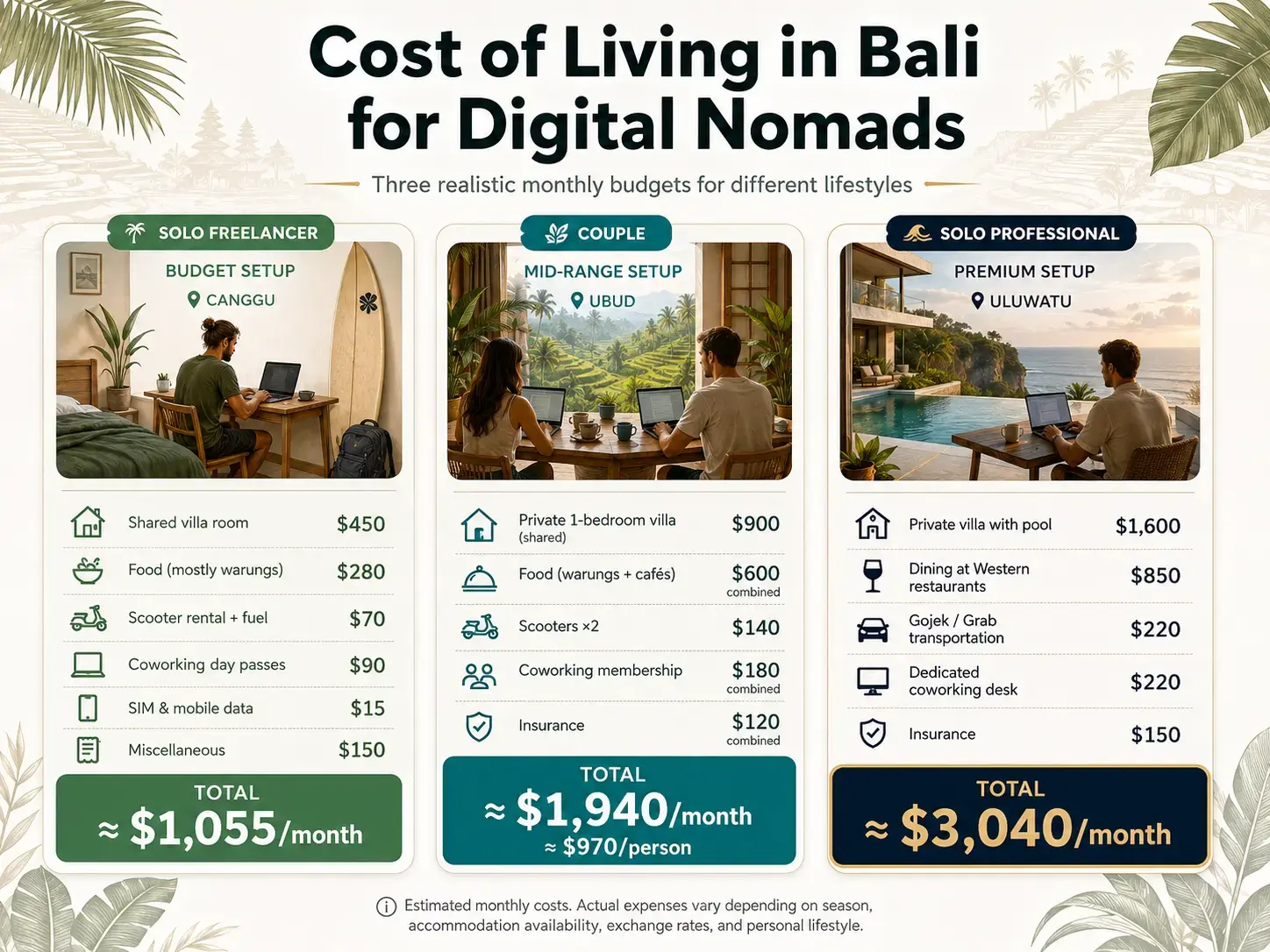
Solo freelancer, budget setup, Canggu: Shared villa room $450, food (mostly warungs) $280, scooter rental and fuel $70, coworking day-passes $90, SIM/data $15, miscellaneous $150. Total: approximately $1,055.
Couple, mid-range setup, Ubud: Private one-bedroom villa $900 (split), food (mix of warungs and cafés) $600 combined, scooter x2 $140, coworking membership $180 combined, insurance $120 combined. Total: approximately $1,940 combined, ~$970 per person.
Solo professional, premium setup, Uluwatu: Private villa with pool $1,600, dining mostly at Western restaurants $850, Gojek/Grab in place of scooter $220, dedicated coworking desk $220, insurance $150. Total: approximately $3,040.
Common Cost Mistakes First-Timers Make
- Underestimating visa run and extension costs as a recurring line item, not a one-off
- Forgetting scooter maintenance and accident excess — minor repairs are frequent and rarely covered casually
- Ignoring currency conversion fees on international transfers; services like Wise typically beat standard bank rates significantly
- Budgeting food at Western-restaurant prices while planning a "budget" lifestyle — the two are inconsistent
Decision framework: if monthly income after tax and business costs is under $2,000, budget-tier Canggu, Ubud, or Sanur is realistic. Above $3,000, Uluwatu or premium Seminyak becomes comfortable without major compromise.
Accommodation and Long-Term Housing Networks
Public listing platforms show a fraction of real inventory. Long-term villa deals move fastest through WhatsApp agent networks and closed Facebook groups such as Canggu Community Housing, often 10–20% cheaper than the same property listed publicly.
Practical recommendation: book short-term (2–4 weeks) accommodation on arrival, then house-hunt in person. Signing a 6–12 month lease sight-unseen is one of the most common regrets among first-year nomads.
The Best Places to Base Yourself in Bali
Area Comparison Table
Which Area Fits Which Lifestyle
- Want maximum networking and shortest coworking commute: Canggu
- Want to actually finish deep work without distraction: Ubud
- Want scenery and don't mind driving further for errands: Uluwatu
- Want a "grown-up" base near the airport with less chaos than Canggu: Seminyak
- Traveling with family or want a slower daily rhythm: Sanur
Canggu: The Bustling Social and Coworking Hub
The much-discussed "Canggu shortcut" back-roads network is now as congested at peak hours as the main roads it was built to bypass — a 2km trip can genuinely take 20 minutes at 5pm. Local insight: Berawa tends to run more polished and pricier; Batu Bolong and Pererenan (technically adjacent) run slightly cheaper with a younger, more transient crowd.
Common mistake: choosing accommodation based on map distance to a coworking space rather than actual drive time during peak traffic.
Ubud: Jungle, Culture, and Wellness
Ubud has no beaches — a detail that surprises a meaningful share of first-time visitors who assumed "Bali" meant coastal by default. What it offers instead is consistency: fewer distractions, an established wellness and yoga community, and a noticeably calmer daily rhythm suited to sustained focus work.
Uluwatu: Surfing and Cliffside Quiet
Uluwatu's infrastructure has improved quickly but remains less uniformly reliable than Canggu or Seminyak. Practical recommendation: before signing a longer lease, test the specific villa's internet speed and stability for at least a few days, since quality varies noticeably street to street.
Seminyak and Sanur: Alternative Bases for Nomads
Seminyak suits nomads who want Canggu's convenience without its density — upscale dining, established venues, and a shorter run to Ngurah Rai Airport. Sanur, on the calmer east coast, is the practical choice for anyone prioritising routine over social scene.
Infrastructure: Wi-Fi, Coworking, and Networking
Fiber vs Mobile Data vs Starlink: Decision Framework
Common mistake: relying entirely on villa Wi-Fi with no backup. Outages during rainy season are common enough that a mobile hotspot or a nearby reliable venue should be treated as standard practice, not a contingency plan.
Coworking Spaces vs Café Working vs Hybrid Venues
Formal coworking memberships suit those needing consistent desks and quiet calls; cafés suit shorter, informal sessions but rarely offer reliable power access during peak hours. A third category — hybrid venues combining serious workspace infrastructure with food, drink, and community — has grown specifically to close that gap.
Coworking selection checklist:
- Confirm actual measured speed, not advertised speed
- Check outlet availability at typical work hours (not just off-peak)
- Test noise levels during a real working session, not a quick visit
- Ask about day-pass vs membership pricing before committing
Eden Hookah Club: From Daytime Productivity to Evening Networking
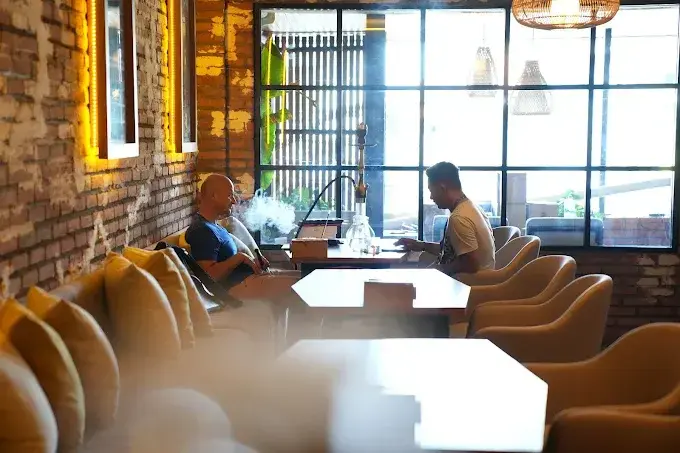
Most coworking options in Bali force a choice: serious workspace infrastructure, or a genuine social scene — rarely both in one location. Eden Hookah Club is one of the few venues built to bridge that gap, functioning as a reliable base for focused work by day and a natural networking spot by evening, without requiring a change of venue.
Why this matters for trust, not just comfort: Eden Hookah Club holds standing as a seven-time International Hookah Battle Champion and a Top 10 placement in the Hookah Battle International Hall of Fame — credentials that place it among a small group of globally recognised hookah destinations. For a remote worker choosing between an unvetted café and a venue with a verified competitive track record, that distinction is a genuine quality signal, not just a marketing line.
Eden operates four strategically located venues in Seminyak, Canggu, Ubud and Uluwatu, which matters more than it first appears. A remote worker based in Ubud for a quiet writing week can land in Canggu the following weekend and still have a familiar, reliable workspace waiting — no re-scouting a new café's Wi-Fi or outlet situation from scratch.
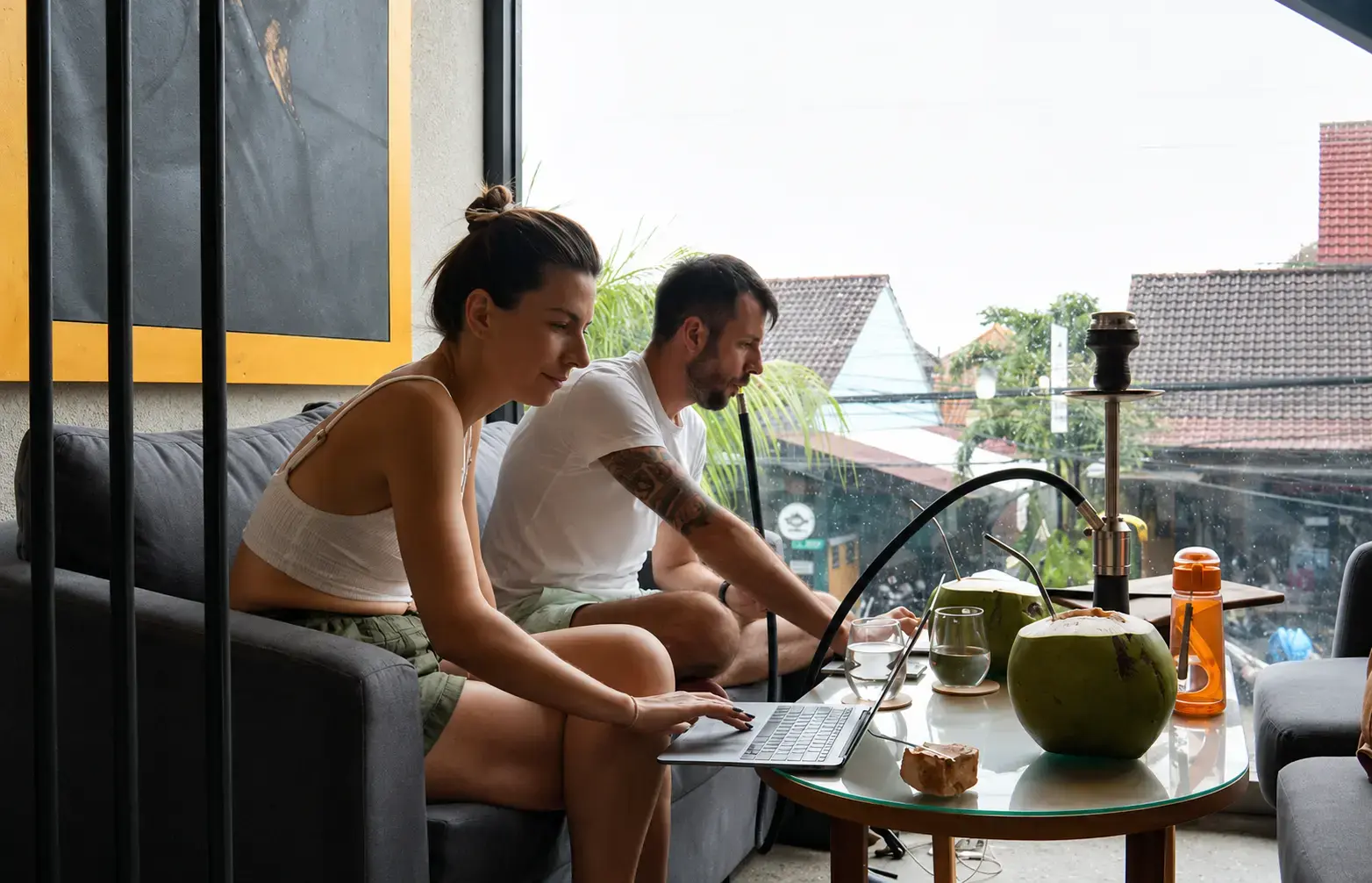
Each venue runs on Starlink internet at approximately 150–300 Mbps, fast enough to hold video meetings, sync cloud-based project files, and move large file transfers without the buffering that villa Wi-Fi occasionally struggles with during peak hours or rain. This directly addresses one of the most common fears raised earlier in this guide: losing connectivity mid-session during rainy season. Eden's venues are set up with backup power arrangements alongside redundant internet lines, so a local grid outage or a single connection drop doesn't necessarily mean a lost work session — a meaningful difference from relying on a single villa's Wi-Fi and hoping the power stays on.
Paired with dedicated power outlets at every table and seating designed for extended laptop use, the setup solves the two most common café-working complaints: dying battery and unstable connection.
For anything requiring more privacy than an open floor — a client pitch, a sensitive call, a small team meeting — the Seminyak, Ubud and Uluwatu venues each offer a VIP room, giving remote workers a genuinely private setting without needing to book a separate meeting space elsewhere. This is a detail easy to overlook when comparing coworking options, but it solves a real gap: open coworking floors and cafés rarely offer anywhere private enough for a serious meeting.
Insider tip: for anyone working across multiple Bali hubs in a single month, treating Eden's four locations as a consistent "home base" — same setup, same reliability, different scenery — removes one of the more underrated sources of remote-work friction: relearning a new workspace every time the base city changes.
The same table used for a 2pm client call can transition directly into an evening spent over dinner and shisha, with no venue change required. Eden offers a Western-Asian fusion menu carried through both parts of the day, giving remote workers a genuine meal option rather than the usual café compromise of pastries and instant noodles, and a proper dining experience once the laptop closes.
By evening, the draw shifts to what Eden is best known for: halal food, drinks and award-winning shisha, served within an international community where meeting fellow entrepreneurs, freelancers, creators, and remote professionals tends to happen naturally rather than through forced networking formats.
Curious what actually separates a good session from an average one? Read the full breakdown of the best hookah brands in 2026 — Eden's lounges stock several of the brands featured, so it doubles as a practical way to try a few before deciding what's worth owning. And for anyone who has never smoked shisha before and wants to know what to expect on a first evening out, Eden's beginner's guide to trying hookah for the first time covers etiquette, flavour choices, and common first-timer mistakes worth knowing before that first session.
More detail on how the venues function as day-to-night workspaces is covered in Eden Hookah Club's coworking overview.
Eden Hookah Club Seminyak
- Instagram : Eden Hookah Club Seminyak
- Reservation : Whatsapp
- Open Daily: 10.00-03.00
- Google Maps : Eden Lounge Seminyak — Restaurant with Live Music
Eden Hookah Club Canggu
- Instagram : Eden Hookah Club Canggu
- Reservation : Whatsapp
- Open Daily: 10.00-03.00
- Google Maps : Eden Lounge Canggu
Eden Hookah Club Ubud
- Instagram : Eden Hookah Club Uluwatu
- Reservation : Whatsapp
- Open Daily: 11.00-03.00
- Google Maps : Eden Lounge Uluwatu — Restaurant with live music
Eden Hookah Club Uluwatu
- Instagram : Eden Hookah Club Ubud
- Reservation : Whatsapp
- Open Daily: 11.00-02.00
- Google Maps : Eden Lounge Ubud
Daily Life and Productivity as a Nomad in Bali
Time zone reality: Bali (WITA, UTC+8) sits awkwardly for US-client calls, typically requiring evening or very early morning availability. European clients overlap more comfortably in Bali's afternoon. Practical recommendation: confirm realistic overlap hours with primary clients before committing to a long lease in a specific area — this affects daily routine more than location choice does.
Local payment habits: cash remains standard for warungs and smaller transactions; QRIS (Indonesia's unified QR payment system) has become widely accepted for cafés, coworking spaces, and larger vendors, and is generally more convenient than carrying large cash amounts.
A realistic weekday scenario: morning scooter commute before traffic builds, 4–5 hours focused work at a coworking venue with backup mobile data on standby, afternoon errands or gym, evening client call timed to overlap, dinner and informal networking. The structure that works best treats commute timing as seriously as the work itself, given how sharply traffic conditions shift by hour.
Things First-Time Digital Nomads Rarely Expect
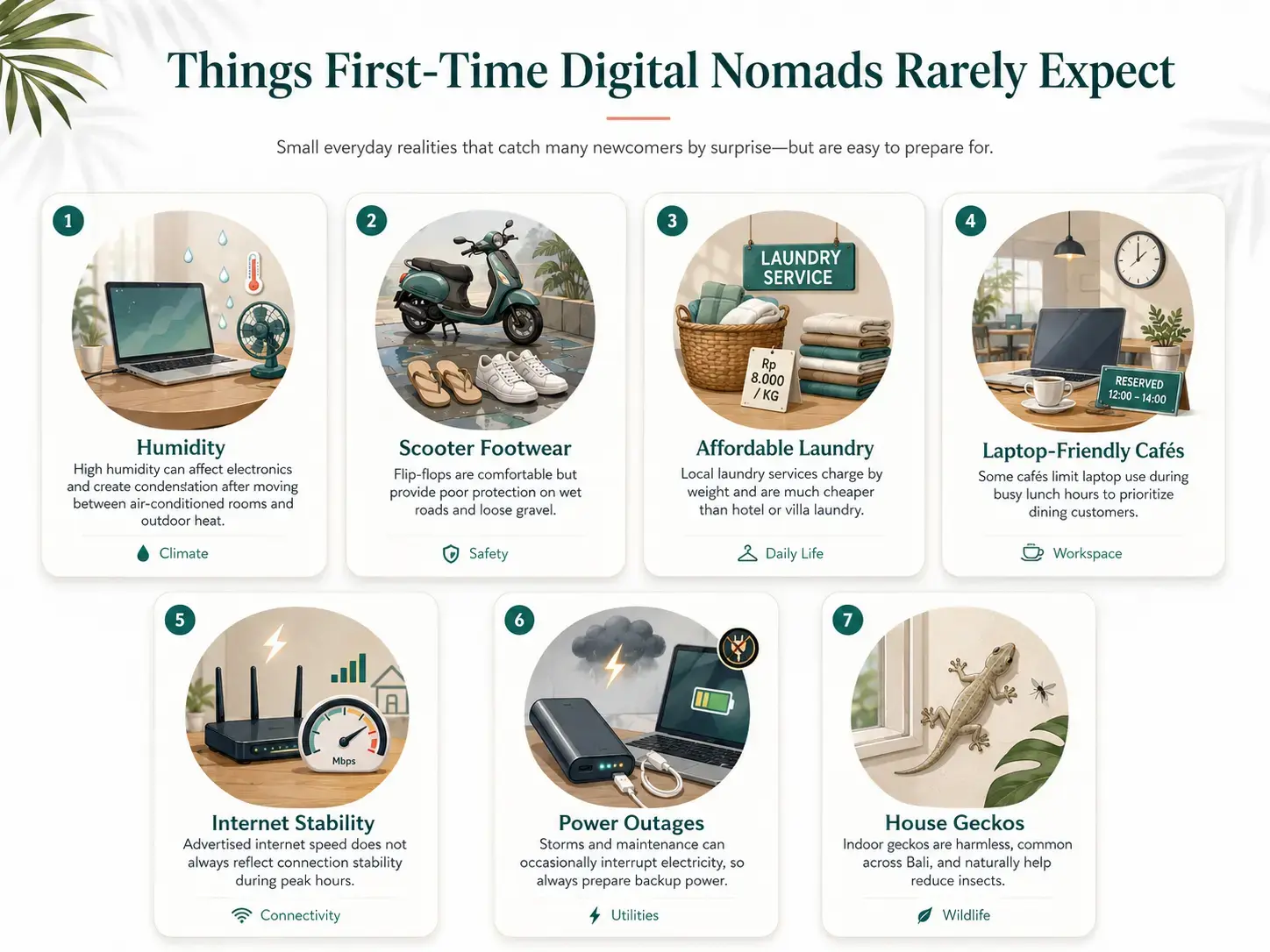
Beyond visas, budgets, and Wi-Fi, it is the small, unglamorous details that catch most newcomers off guard in the first month. None of these are dealbreakers — but knowing them in advance saves real frustration.
The Realities of Living in Bali
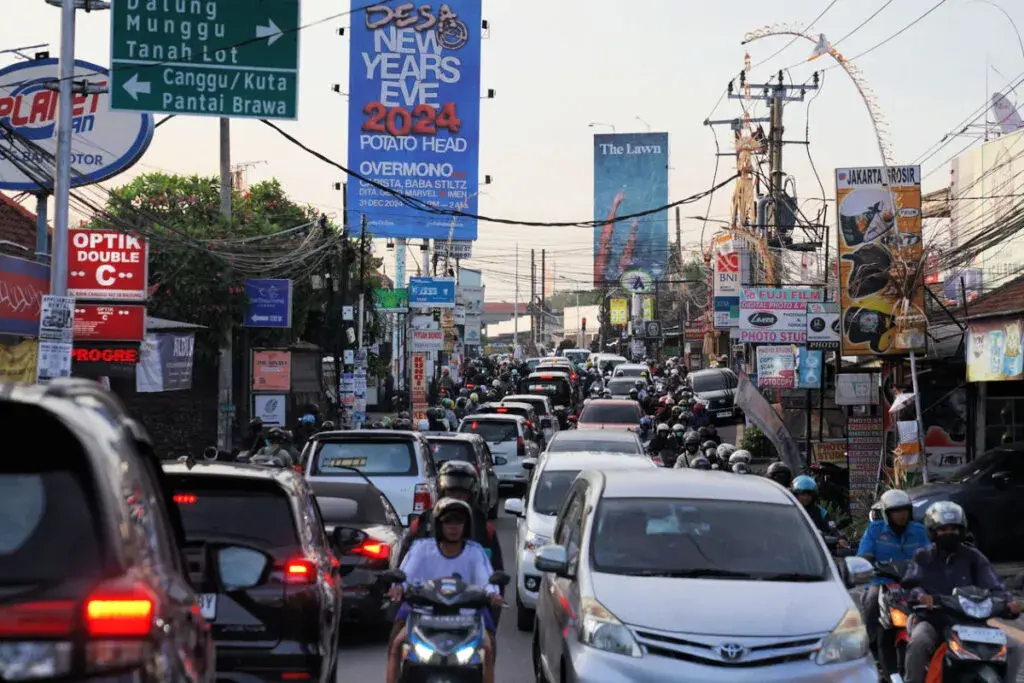
Getting Around: Scooter vs Ride-Sharing Decision Framework
Practical recommendation: use ride-sharing exclusively for the first two to three weeks while learning local traffic patterns, then reassess whether a scooter genuinely saves enough to justify the added risk.
Medical Insurance and Top Hospitals
Comprehensive travel medical insurance is close to non-negotiable; providers like Genki Insurance are commonly used within the nomad community. For anything beyond minor treatment, BIMC and Siloam are the most reliable English-speaking hospital networks near major hubs.
Bali Belly prevention checklist:
- Avoid tap water and ice from unverified sources
- Be cautious with raw seafood from lower-turnover street vendors
- Carry basic rehydration salts as a standard travel item, not an emergency purchase
- Know the nearest hospital location before it's needed, not during a crisis
The Downsides: Rainy Season and Trash Season
Rainy season (roughly October–March) brings heavy afternoon downpours that flood low-lying roads and disrupt scooter commutes with real regularity, not occasionally. Trash season, when monsoon currents wash debris onto west-coast beaches, is a predictable seasonal pattern worth planning around rather than treating as a rare disappointment.
The Nyepi Shutdown: When the Island Goes Silent
Nyepi, the Balinese Day of Silence, shuts the entire island for 24 hours annually — airport, businesses, and in most areas, internet access included. Practical recommendation: confirm the date each year in advance, inform clients of a full-day unavailability window, and stock essentials the day before, since even food delivery stops entirely.
Common Mistakes First-Time Nomads Make in Bali
- Signing a 6–12 month lease before visiting the property or testing internet reliability
- Ignoring the rolling 183-day tax residency clock
- Treating scooter riding as low-risk without local experience
- Underbudgeting for visa extensions, insurance, and scooter maintenance as recurring costs
- Skipping travel medical insurance to save a relatively small monthly amount
- Assuming villa Wi-Fi alone is sufficient without a backup connectivity plan
- Overlooking Nyepi and other local shutdowns when planning client deadlines
30/60/90-Day Setup Checklist for Moving to Bali
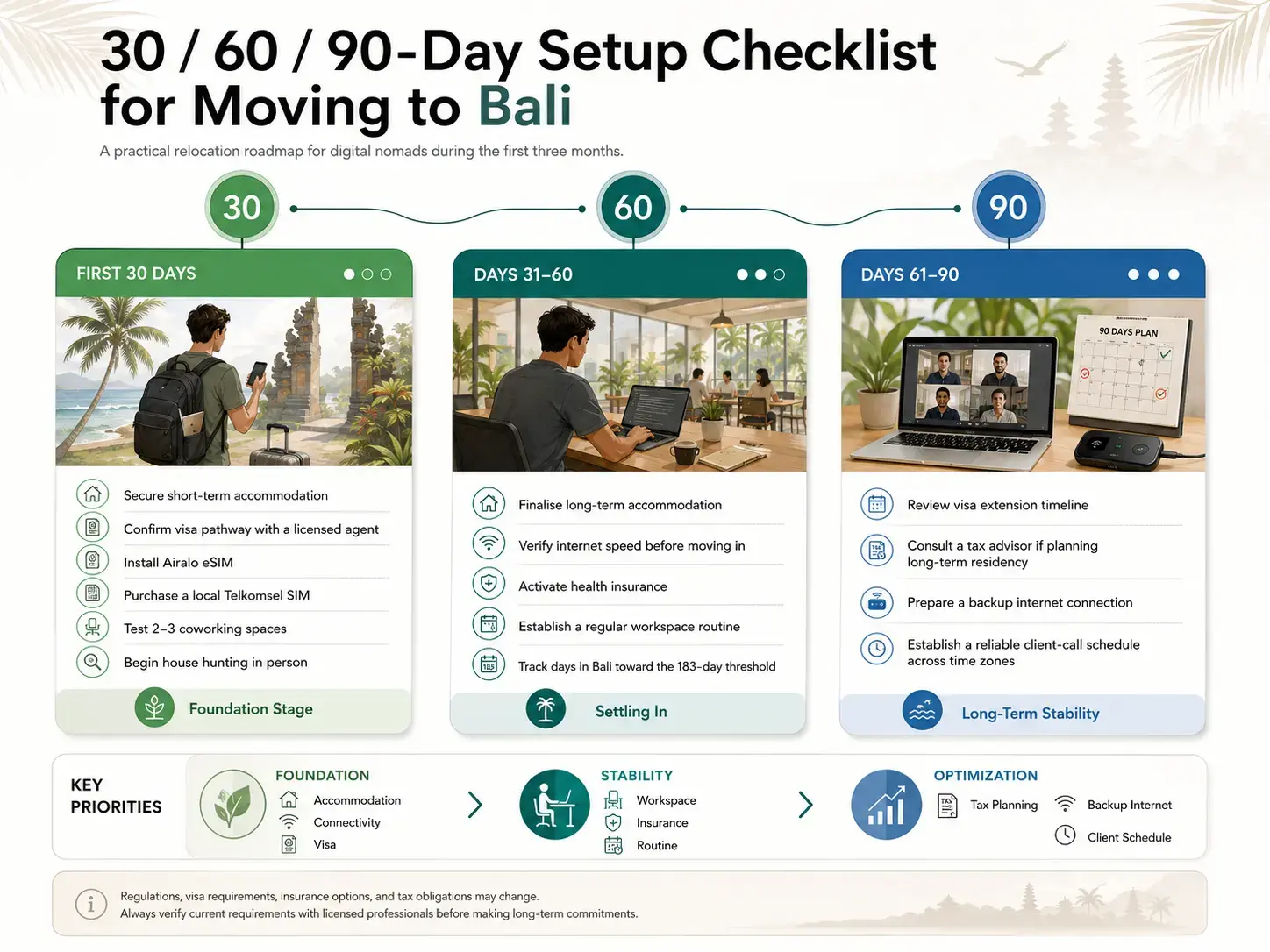
First 30 days:
Secure short-term accommodation, confirm visa pathway with a licensed agent, get a local SIM (Telkomsel) alongside an initial Airalo eSIM, test 2–3 coworking or hybrid venues, begin house-hunting in person rather than online.
Days 31–60:
Finalise longer-term accommodation with verified internet, register for insurance if not already active, establish a regular coworking or workspace routine, start tracking days in-country toward the 183-day threshold.
Days 61–90:
Review visa extension timeline well ahead of expiry, consult a tax advisor if approaching long-term residency, build a backup connectivity plan (mobile hotspot or verified venue), establish a consistent client-call schedule around time zone overlap.
Is Bali Still Worth It for Digital Nomads?
Despite rising living costs, stricter visa enforcement, and increasingly busy hotspots, Bali remains one of the most complete destinations for remote professionals anywhere in the world.
Few places combine reliable infrastructure, established digital nomad communities, diverse lifestyles, and year-round opportunities to work, explore, and build meaningful professional connections in quite the same way.
Success in Bali rarely depends on finding the cheapest villa or the trendiest café. It comes from making informed decisions early — choosing the right visa, selecting a neighbourhood that matches the way work actually happens, and building a realistic monthly budget.
For anyone willing to plan before arriving — using the visa, budget, and location frameworks outlined above rather than learning everything through expensive mistakes — becoming a digital nomad in Bali can still be one of the most rewarding long-term lifestyle decisions available in Southeast Asia.
Looking for a Reliable Place to Work and Network in Bali?
A productive workspace is about more than fast Wi-Fi — seating, reliable power, good food, and an active community all matter over a long workday.
Eden Hookah Club offers exactly that across Seminyak, Canggu, Ubud, and Uluwatu, with Starlink-powered internet, dedicated outlets, and a natural shift from daytime focus to evening networking.
FAQ Section
Is it legal to be a digital nomad in Bali?
Yes, if the correct visa is used. The E33G Remote Worker Visa is the only category explicitly authorising remote work for overseas clients; working on a tourist visa carries genuine legal risk.
How much does it realistically cost to live in Bali as a digital nomad?
Budget setups run around $1,000–$1,300 a month solo; mid-range comfortable setups around $1,900–$2,200; premium setups with private pool villas and full coworking memberships from $3,000 upward.
Which visa should a first-time nomad choose?
Those staying long-term with documented overseas income should pursue the E33G. Those testing the lifestyle for under two months typically use the B211A, understanding its legal grey area for remote work.
Do digital nomads have to pay Indonesian tax?
Anyone present 183+ days within a rolling 12-month period becomes a tax resident liable on worldwide income, generally requiring NPWP registration — regardless of visa category.
Which area in Bali is best for a first-time digital nomad?
Canggu suits those prioritising coworking density and social life despite traffic; Ubud suits focused, quieter work; Uluwatu suits those wanting scenery and space; Sanur and Seminyak suit calmer or more convenience-driven routines.
Is Bali's internet reliable enough for full-time remote work?
Fiber is standard in major hubs but varies from villa to villa, and outages occur during the rainy season. A backup plan — mobile data or a Starlink-backed venue — is standard practice rather than optional.
Does Eden Hookah Club offer dedicated high-speed Wi-Fi packages for remote workers?
There's no separate paid Wi-Fi plan to purchase — the same Starlink connection, running at approximately 150–300 Mbps, is available to all dine-in guests across all four venues. For a remote worker, that means video calls, file transfers, and cloud syncing are covered as part of ordering food or a shisha session, without needing to sign up for anything extra.
Which Eden Hookah Club location has the quietest zone for Zoom calls?
For a genuinely private call or meeting, the Seminyak, Ubud, and Uluwatu venues each have a VIP room available, which is a more reliable option than hunting for a "quiet corner" in an open coworking floor. In terms of general daytime noise, Ubud tends to run calmest overall. Uluwatu is quiet through the day but picks up noticeably around sunset and dinner hours, so it's better suited to daytime calls than evening ones — plan accordingly if timing is flexible.
What do first-time nomads usually get wrong about Bali?
Underestimating recurring costs (visa extensions, scooter upkeep, insurance), signing leases without visiting in person, and misunderstanding the 183-day tax rule as calendar-year rather than rolling.
Sources & Further Reading
Visa & Immigration
- Directorate General of Immigration, Republic of Indonesia (official e-Visa portal) — evisa.imigrasi.go.id
- Directorate General of Immigration — main site — imigrasi.go.id
Tax & NPWP
- Direktorat Jenderal Pajak (Indonesia's Directorate General of Taxes) — official guidance on tax residency and the 183-day rule for foreign citizens — pajak.go.id
Healthcare
- BIMC Hospital Bali (official site) — bimcbali.com
- Bali International Hospital (official site) - bih.id
- Siloam Hospitals (official group site) — siloamhospitals.com
Connectivity
- Telkomsel official eSIM/tourist SIM page — telkomsel.com/en/esim
Nyepi & Local Culture
- The Bali Times — Nyepi 2026 islandwide shutdown coverage, confirmed for March 19 — thebalitimes.com
- Eden Hookah Club — complete Nyepi 2026 guide, including Ogoh-Ogoh parade locations and pre-Nyepi delivery cut-off times — edenhookah.com